
What Separates High School Athletes from College Athletes? It’s Not Talent.


Every high school athlete thinks they work hard.
That is not an insult. It is just usually incomplete.
I have had this conversation with hundreds of athletes over the years. A high school athlete walks into Stadium Performance with confidence because they were the best player on their team, all-conference, maybe all-state, maybe the athlete everybody in town talks about. Their parents believe college coaches are going to love them because they dominate locally.
Their coaches believe the athlete “just needs exposure.”
Then they step onto a college campus. And reality arrives quickly. The jump from high school athletics to college athletics is not subtle. It is not incremental. It is violent.
The difference is not simply that athletes get bigger, faster, and stronger. The difference is that the margin for physical weakness, movement inefficiency, poor recovery habits, and inconsistent effort disappears immediately. That is what most young athletes misunderstand about college athlete conditioning.
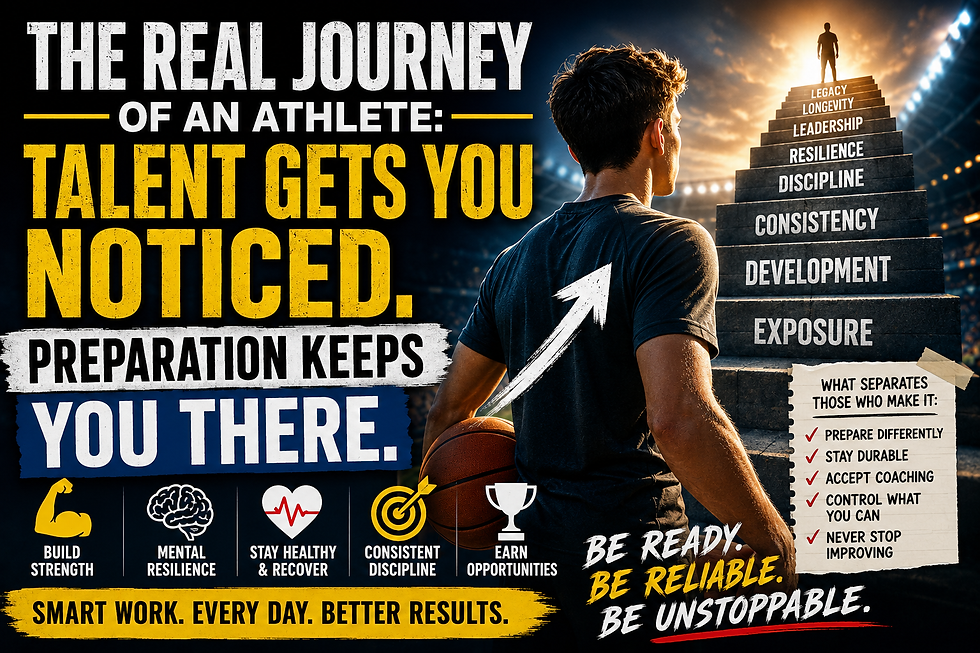
Talent Gets You Recruited. Capacity Gets You on the Field.
I have worked with youth athletes, high school athletes, college athletes, professional athletes, and organizations where performance is not theoretical conversation—it is employment. One lesson becomes obvious fast: nobody cares what level you dominated previously.
College programs are not evaluating your high school highlight reel once preseason starts. They care whether you can survive the workload. That distinction matters more than athletes realize.
A highly talented high school basketball player may average twenty points a game because they are more athletic than everyone else in their conference. A soccer player may dominate because their first step is elite compared to local competition. A baseball player may overpower weaker hitters with velocity alone.
That stops working when everyone in the room was the best player somewhere else.
Now your natural advantages become baseline expectations. This is where sports performance training either shows up or gets exposed.
The Physical Gap Is Bigger Than Most Families Realize
One of the biggest mistakes parents make is assuming their child’s current success predicts future readiness.
It does not.
Research examining Division I strength coaches found consistent concerns about incoming freshman athletes lacking lower body strength, core strength, mobility, movement competency, nutrition knowledge, and recovery awareness. That should get every serious family’s attention.
Because this is not about whether your child “works out.”
It is about whether they are physically prepared for collegiate demands.
College athletes are not just stronger versions of high school athletes. They are typically operating with higher force production capacity, greater training density, more advanced strength and conditioning, more sophisticated recovery expectations, and dramatically less tolerance for physical weakness.
And no, posting squat videos on Instagram does not automatically qualify as preparation.
Effort Becomes the Great Separator
I recently listened to Coach Izzo discussing college basketball and one point stood out because it reflects what I have seen for years: physical limitations can absolutely be overcome, but only when effort becomes non-negotiable.
That is where many athletes get exposed. High school athletes can often succeed through talent and selective effort. College athletes cannot.
At the collegiate level, effort is no longer an emotional concept. It becomes a measurable survival trait. Can you train hard when your body is tired? Can you execute when your classes are crushing you? Can you recover properly instead of living on caffeine, poor sleep, and convenience food? Can you handle coaching that is direct, demanding, and uninterested in excuses?
Because college athletics introduces dual stressors. Student-athletes are not simply performing physically. They are balancing academic demands, training loads, travel, recovery, and performance expectations simultaneously, which creates real pressure on both athletic and personal systems.
That adjustment breaks more athletes than poor vertical jump numbers.
The Movement Quality Problem Nobody Talks About
This is where my sports medicine background makes me particularly blunt.
Many high school athletes are not underdeveloped because they lack motivation.
They are underdeveloped because nobody actually assessed what they needed.
At Stadium Performance, our athlete assessments routinely identify athletes who have spent years training hard while reinforcing dysfunctional movement patterns.
Poor hip mobility.
Weak posterior chain development.
Terrible deceleration mechanics.
Asymmetrical loading.
Core instability.
Inefficient acceleration posture.
Limited force absorption.
The athlete feels “strong” because they can complete workouts. That is not the same as being physically efficient. College sport punishes inefficiency quickly.
A movement dysfunction that high school competition tolerated becomes soft tissue injury, chronic soreness, lost confidence, or reduced playing time at the next level. That is exactly why injury prevention, intelligent speed and agility training, and individualized programming matter.
The Psychological Gap Is Real Too
The transition to college athletics is not simply physical.
Many athletes struggle because their identity gets challenged for the first time. In high school, they were the star. In college, they may be the fourth fastest freshman. Or the smallest guard. Or the weakest pitcher. Or the athlete rehabbing while everyone else is competing.
That psychological transition matters.
Some athletes become obsessed with proving themselves immediately and overtrain. Others withdraw when they realize effort alone does not instantly solve the gap. The athletes who thrive are usually the ones who embrace development instead of resenting reality.
College is not confirmation that you made it. It is proof the real work starts now.
What Stadium Performance Actually Prepares Athletes For
This is exactly why our model at Stadium Performance is built around long-term athletic development, not random workouts designed to make athletes tired. Our private training, group training, sports performance training, athlete assessments, return to play systems, and injury prevention programming are designed to prepare athletes for the actual demands of competition—not performative fitness.
That means developing:
force production
repeat effort capacity
movement efficiency
acceleration and deceleration control
sport transfer
tissue durability
recovery discipline
competitive resilience
Because college athlete conditioning is not about looking prepared.
It is about being prepared.
For Athletes, Parents, and Coaches
Athletes, if your plan is to “flip the switch” when college starts, that plan is garbage.
Parents, if your athlete is succeeding locally and you assume that guarantees readiness, you are evaluating the wrong metrics.
Coaches, if development conversations stop at skill work and team conditioning, you are leaving critical physical development untouched.
The gap between high school and college athletics is not mysterious. It is measurable. And for athletes willing to address it honestly, it is absolutely trainable. At Stadium Performance, that is exactly what we do.


When selecting an online literacy service for a child, it is reasonable to look at the actual structure behind the claims. Many platforms mention structured plans, but looking directly at options like https://brighterly.com/reading-program/ allows parents to see how individual grade bands are handled. In practice, early grades usually focus on phonics and letter recognition, while older students require work on vocabulary and comprehension for longer texts.
The main factor is whether a service adapts to individual learning gaps instead of using a standard curriculum. Tutors on these platforms typically hold education degrees and focus on one on one sessions. This format can help with specific needs like decoding or fluent reading, though progress naturally varies depending on the student and consistency…