
Your Cleats Might Be Increasing Your ACL Risk: What Every Athlete, Parent, and Coach Needs to Know


Every year, athletes spend thousands of dollars on training, recovery tools, strength programs, nutrition plans, and private coaching in an effort to improve performance and reduce injury risk. Yet one of the most overlooked pieces of equipment in sports may be sitting at the bottom of a locker, covered in mud, turf pellets, or grass stains.
The cleats
Most athletes choose cleats based on comfort, brand loyalty, appearance, or what their favorite professional player wears. Parents often assume that if a major manufacturer sells a particular model, it must be appropriate for the surface their child plays on. Coaches rarely have conversations about footwear beyond requiring athletes to wear the correct type for competition.
The problem is that footwear selection is not simply a fashion decision. It is a biomechanics decision.
Over the past two decades, as artificial turf fields have become increasingly common, researchers have spent considerable time studying the interaction between footwear, playing surfaces, and injury risk. While ACL injuries are multifactorial and no single factor causes every injury, there is growing evidence that the wrong combination of cleat design and playing surface can increase rotational forces transmitted into the knee. For athletes who already possess movement dysfunctions, strength deficits, or poor deceleration mechanics, that additional force may become the final straw.
The ACL Does Not Usually Tear Because an Athlete Is Weak
One of the biggest misconceptions surrounding ACL injuries is that they happen because athletes are not strong enough.
In reality, many ACL injuries occur because force gets trapped.
The athlete plants.
The body rotates.
The foot stays fixed.
The knee absorbs the consequence.
As a sports medicine professional since 2002, I have evaluated countless athletes after knee injuries. Whether I was working with youth athletes, supporting collegiate programs, traveling around Major League Baseball organizations, or working within professional sports environments, one theme consistently emerged: the body can only tolerate so much force before something has to give.
When the foot can rotate naturally against the playing surface, some of that rotational stress dissipates harmlessly. When the shoe locks into the ground and refuses to release, those forces must travel somewhere else. Frequently, they travel up the kinetic chain into the ankle, knee, hip, or lower back.
The ACL often becomes the victim.
What the Research Actually Shows
A fascinating engineering study published in the American Journal of Engineering and Applied Sciences directly examined the relationship between soccer shoe design, playing surfaces, and rotational torque. Researchers tested various cleat configurations on both natural grass and artificial turf using controlled laboratory conditions designed to simulate athletic pivoting movements.
Their findings were difficult to ignore.
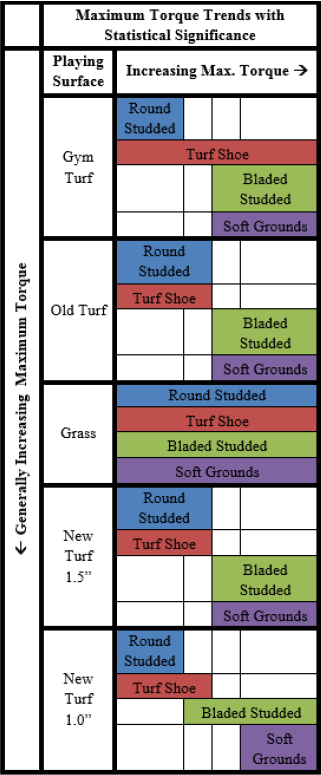
Round-studded cleats and turf shoes consistently
generated lower rotational torque

values than bladed cleats and soft-ground stud configurations. The researchers concluded that round studs allowed the shoe to rotate more naturally within the playing surface, while bladed studs created greater resistance and higher torque levels.
Even more interesting was the impact of the playing surface itself.
Natural grass demonstrated a unique ability to deform and absorb force. Instead of allowing torque to continue increasing, the grass often failed first by tearing or deforming, effectively limiting rotational stress. Artificial turf surfaces, particularly newer turf systems with aggressive traction characteristics, produced substantially higher torque values.
The researchers ultimately recommended natural grass paired with round-studded cleats as the safest combination. For athletes competing on artificial turf, they recommended turf shoes or round-studded cleats over bladed configurations because they allowed safer rotational release.
Why This Matters More Today Than Ever
The reality facing today's athletes is that avoiding artificial turf is becoming increasingly difficult.
High school football programs play on turf. Soccer tournaments are held on turf. Lacrosse facilities are built around turf.
Many indoor training centers operate exclusively on synthetic surfaces.
As artificial surfaces have expanded, footwear technology has simultaneously evolved toward maximizing traction. From a performance standpoint, that sounds appealing. More traction should theoretically mean faster acceleration, harder cuts, and greater explosiveness.
The problem is that there appears to be a point where more traction stops helping and starts becoming a liability.
Athletes need enough traction to produce force effectively. They do not need so much traction that the foot becomes welded to the ground during rotational movements.
Parents often assume that more grip equals better performance. Coaches sometimes associate aggressive stud patterns with toughness or competitive advantage. Athletes frequently choose the most aggressive cleat available because it feels fast.
The human body, however, is not impressed by marketing. Biomechanics always wins.
The Missing Piece: Movement Quality Still Matters
Before anyone rushes out to buy new cleats, it is important to understand that footwear is only one variable in a much larger equation.
At Stadium Performance, we routinely conduct athlete assessments that identify movement dysfunctions long before they become injuries. Some athletes demonstrate poor hip mobility. Others struggle with deceleration mechanics. Some athletes leak force through weak trunk control or poor single-leg stability. Many cannot efficiently absorb force when landing, cutting, or changing direction.
Those deficiencies matter.
A poor movement pattern performed in a safer shoe is still a poor movement pattern.
Likewise, an athlete with excellent biomechanics, strong force absorption capabilities, and exceptional body control can often tolerate environmental stressors better than an athlete whose movement foundation is compromised.
This is why injury prevention cannot begin and end with equipment choices. True sports performance training requires addressing the entire system. Footwear, strength and conditioning, movement quality, speed and agility training, recovery strategies, and force management all influence injury risk.
The cleat matters. The athlete matters more.
What Athletes, Parents, and Coaches Should Consider


Athletes should evaluate whether their footwear matches the surfaces they actually play on rather than the surfaces advertised on the box. Parents should ask questions about cleat selection with the same level of seriousness they apply to helmets, mouthguards, or other protective equipment. Coaches should recognize that injury prevention extends beyond practice plans and conditioning sessions.
When athletes spend the majority of their time on artificial turf, footwear choices deserve thoughtful consideration. Aggressive blade-style studs may provide exceptional traction, but they may also increase rotational forces during cutting and pivoting activities. Round-studded designs often provide a more forgiving interaction with the playing surface while still supporting high-level performance.
Most importantly, athletes should understand that no cleat can compensate for poor movement quality.
The athletes who stay healthy longest are rarely the athletes chasing shortcuts. They are the athletes who consistently build strength, improve movement efficiency, develop deceleration skills, and respect the demands their sport places on the body.
The Bigger Conversation About Sports Injury Prevention
One of the reasons we emphasize athlete assessments, sports performance training, injury prevention strategies, and return to play programming at Stadium Performance is because injuries rarely occur in isolation.
An ACL tear is often presented as a random event.
In reality, it is usually the culmination of multiple contributing factors.


Movement dysfunction.
Fatigue.
Poor force absorption.
Training deficits.
Surface interactions.
Footwear choices.
Biomechanics.
When enough risk factors stack on top of one another, the margin for error disappears.
The goal is not to create fear around cleat selection. The goal is to help athletes, parents, and coaches understand that small decisions can have meaningful consequences over time.
Your cleats alone may not tear your ACL.
But if they are increasing rotational stress on a body that already struggles to manage force efficiently, they may be contributing to a problem that was waiting to happen.
That is a conversation worth having before the season starts—not after surgery is scheduled.


Bài của bạn viết rất rõ ràng, vào thẳng ý chính nên mình đọc một lượt là nắm được ngay, cảm ơn bạn đã chia sẻ. Mình cũng có thói quen theo dõi thống kê XSMB mỗi ngày để tiện đối chiếu, nhưng trước đây cứ cần xem lại là phải mở nhiều nơi khác nhau, khá mất công. Gần đây mình thử tự gom những số liệu hay dùng vào một chỗ để tra nhanh hơn, kiểu chỉ cần mở lên là xem được theo từng ngày. https://soicau247.com/ là chỗ mình thỉnh thoảng ghé để nhìn lại cho tiện, chủ yếu phục vụ việc so sánh nhanh chứ không phải lúc nào cũng nhớ hết. Nói chung bài của…